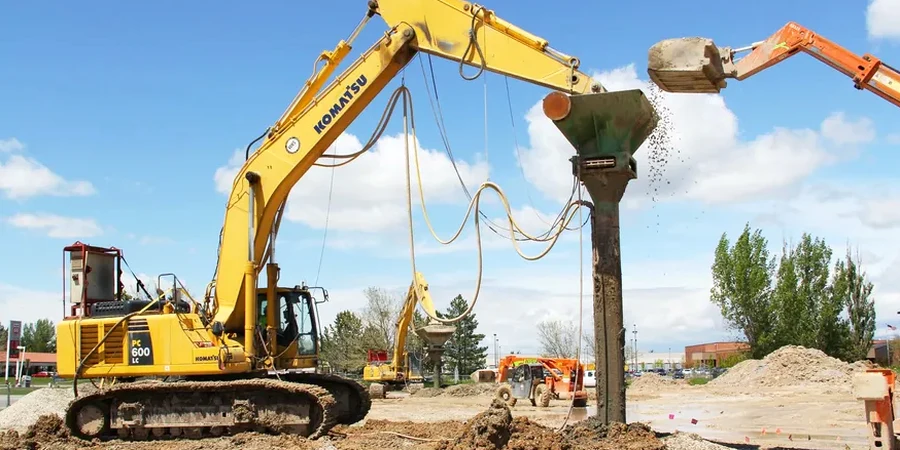
Ground improvement in Ashford encompasses a critical suite of geotechnical techniques designed to enhance the engineering properties of soils, ensuring they can safely support foundations, roads, and infrastructure. Rather than excavating and replacing weak ground, these methods modify the soil mass in situ, increasing bearing capacity, reducing settlement, and mitigating liquefaction potential. For a town experiencing steady residential and commercial expansion, such as Ashford, the strategic application of ground improvement is not merely a technical option but a fundamental necessity for managing development risk and ensuring long-term structural integrity on the area's challenging natural soils.
The local geology of Ashford is dominated by the Weald Clay formation, interspersed with superficial deposits of alluvium, river terrace gravels, and head deposits. The Weald Clay, in particular, presents significant challenges: it is a stiff, overconsolidated clay prone to shrink-swell behaviour with seasonal moisture changes. This volumetric instability can cause subsidence and cracking in lightly loaded structures. Furthermore, the river valleys contain soft alluvial silts and clays with low bearing capacity and high compressibility. These highly variable ground conditions demand a rigorous, site-specific approach to ground investigation and improvement design, making it a central consideration for any construction project in the borough.
Any ground improvement scheme in Ashford must be designed and executed in accordance with the relevant UK and European standards. The overarching code is Eurocode 7: Geotechnical design (BS EN 1997-1 and BS EN 1997-2), complemented by its UK National Annex. Execution is governed by BS EN 14731 for deep vibration and BS EN 15237 for vertical drains. Crucially, the design must also satisfy the requirements of the NHBC Standards for residential developments, particularly Chapter 4.6 for engineered fill. Compliance with these normative documents ensures a verifiable design approach based on limit state principles, covering both ultimate and serviceability limit states, and provides the necessary assurance for Building Control approval and warranty providers.
The types of projects in Ashford that routinely require ground improvement are diverse. Large-scale residential developments on greenfield sites underlain by soft alluvium frequently call for techniques like vibrocompaction design to densify loose granular soils or stone column design to reinforce cohesive, low-strength clays. Commercial and industrial buildings with heavily loaded floor slabs and crane bases on the Weald Clay also benefit from these methods to control differential settlement. Infrastructure projects, including highway embankments and flood defence works, utilise ground improvement to enhance stability and reduce construction time. Even smaller domestic extensions on shrinkable clay may require engineered solutions that fall under this broad category of soil treatment.
The primary purpose is to enhance the poor load-bearing characteristics of Ashford's prevalent Weald Clay and soft alluvial soils. By increasing strength, reducing compressibility, and controlling shrink-swell behaviour, ground improvement prevents excessive settlement and foundation failure, making sites safe for development without the need for deep, costly piled foundations or bulk excavation.
A requirement is determined by a comprehensive ground investigation to BS EN 1997-2. If the report identifies weak, highly compressible, or shrinkable soils at foundation level, and the calculated settlements or bearing resistance exceed Eurocode 7 limit states, then some form of ground improvement will be necessary to mitigate the risk and satisfy Building Control.
The most common techniques are those that address the specific local ground conditions. Vibro stone columns are frequently used to reinforce soft cohesive alluvial deposits, while vibrocompaction is employed to densify loose granular river terrace gravels. Dynamic compaction and soil mixing are other options, but their suitability depends entirely on the soil profile and project-specific constraints.
Ground improvement often provides a more economical and sustainable solution by treating the soil mass in situ rather than bypassing it with piles. It can eliminate the need for piling mats and large quantities of concrete, reduce spoil removal, and allow for conventional shallow footings. This can accelerate the construction programme and significantly lower the project's overall carbon footprint.