GEOTECHNICAL ENGINEERING1
ASHFORD
HomeIn-SituField density test (sand cone method)

Field Density Testing (Sand Cone Method) in Ashford

Knowledgeable. Thorough. Resourceful.

LEARN MORE

Compaction compliance in Ashford starts with reliable in-place density verification. The sand cone method, executed in accordance with BS 1377-9:1990, remains the definitive field check for earthworks on the town's variable drift geology. From residential plots near the Stour to commercial cut-and-fill on the outskirts, we see projects where the difference between a passed test and a failed one comes down to understanding the moisture-sensitive nature of the local Head deposits. Our accredited laboratory delivers results that align with both the Specification for Highway Works (Series 600) and Eurocode 7 (BS EN 1997-2:2007) requirements, giving engineers the confidence to sign off on lift after lift. For deeper strength profiling, the spt-drilling provides complementary data where density alone is not enough.

A single density test on the Folkestone Beds can reveal whether a foundation will settle differentially or perform as designed for decades.
Our service areas

Scope of work

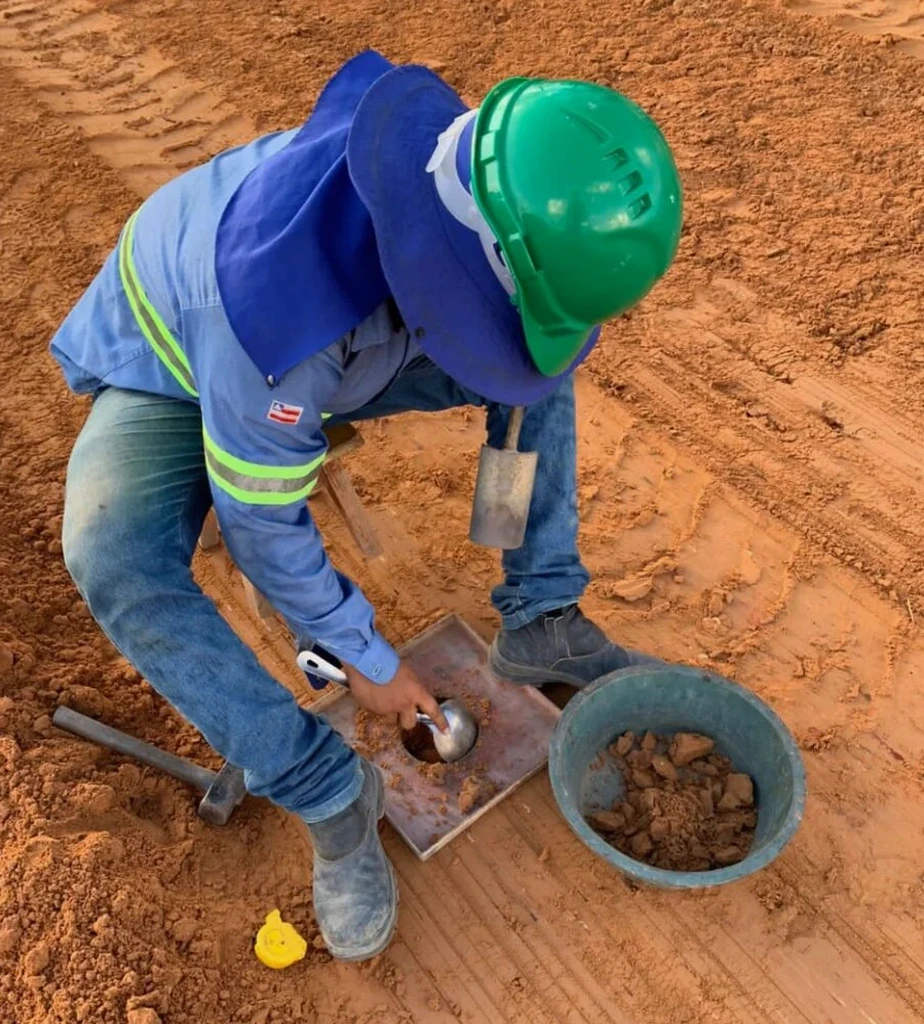
A common mistake on Ashford sites is testing density before the clay fraction in the brickearth has equilibrated following compaction — a practice that yields misleadingly high air voids. The sand cone test measures bulk density directly, and when paired with a Proctor curve from the same material, the degree of compaction emerges with clarity. Our field technicians prepare the test surface on each compacted lift with careful levelling of the sand pouring cylinder base plate. We use calibrated, uniformly graded sand, and the excavated material is sealed immediately to preserve natural moisture. The test hole is dug meticulously through the full lift thickness, avoiding disturbance to sidewalls, and the volume is determined by the mass of sand required to fill it. Every step follows BS 1377-9, and the calculation sheet includes wet density, dry density, moisture content, and relative compaction against the reference maximum dry density.
Field Density Testing (Sand Cone Method) in Ashford
Technical reference — Ashford

Area-specific notes

Ashford sits on a patchwork of Cretaceous Lower Greensand and Gault Clay, overlain by Pleistocene brickearth and river terrace gravels. The brickearth in particular can lose significant strength when compacted outside its optimum moisture window, and density alone does not always flag the risk — a test can pass while the soil structure is already degrading at the micro-scale. On the Folkestone Beds, sands with little cohesion demand rapid testing before drying alters the in-place condition. Inadequate density verification leads to post-construction settlement in lightly loaded residential slabs, cracked services, and failed soakaway installations. When earthworks proceed without a sufficient number of sand cone tests per 1,000 m², the statistical confidence collapses and the client carries the latent defect risk for years. Ashford's growth arc, from Eureka Park to the Chilmington Green expansion, multiplies these exposure points.

Need a geotechnical assessment?

Reply within 24h.

Email: contact@geotechnical-engineering1.com

Standards used


BS 1377-9:1990 — In-situ density tests (sand replacement method), BS EN 1997-2:2007 (Eurocode 7) — Ground investigation and testing, Manual of Contract Documents for Highway Works (MCHW), Volume 1, Series 600

Typical values

ParameterTypical value
Applicable StandardBS 1377-9:1990, BS EN 1997-2
Test Depth per PointTypically 100–200 mm (one compacted lift)
Measured ParametersWet density, dry density, moisture content, relative compaction
Calibration SandUniformly graded, oven-dry silica sand
Reporting FormatField record sheet with location plan and compaction curve overlay
Typical Resolution0.01 Mg/m³ for density, 0.1% for moisture
Sample PreservationMoisture tin filled and sealed on site immediately after excavation

Frequently asked questions


How much does a field density test using the sand cone method cost in Ashford?

A single sand cone density test on a site within the Ashford area typically ranges from £80 to £130, depending on the number of points tested in one mobilisation and the reporting turnaround required. Volume discounts apply when we schedule multiple tests across the same earthworks phase.

At what frequency should sand cone tests be carried out on an Ashford residential development?

For general fill under the Specification for Highway Works, one test per 1,000 m² per compacted lift is the minimum, though on Ashford's brickearth a tighter frequency of one per 500 m² often proves more prudent. Structural fill beneath foundations or retaining walls usually requires at least one test per lift per 200–300 m², with additional points at the engineer's discretion.

Can the sand cone method be used on coarse granular fill containing gravel from the Folkestone Beds?

Yes, provided the maximum particle size does not exceed 37.5 mm and the test hole volume is increased accordingly. On Folkestone Beds material with occasional cobbles, we may switch to a larger sand pouring cylinder or recommend a nuclear density gauge alternative, but for most Ashford sands and sandy gravels the standard sand cone apparatus remains fully suitable.

Location and service area

We serve projects across Ashford and surrounding areas.

View larger map