In Ashford, the management and design of slope stability and earth retaining structures form a critical branch of geotechnical engineering, driven by the town's ongoing expansion and its varied ground conditions. This category encompasses the assessment of natural and man-made slopes, the design of retaining walls, and the implementation of ground anchorage systems to secure earth masses. Whether for new housing developments on the urban fringe, infrastructure corridors like the M20, or commercial plots in areas such as Eureka Park, ensuring the stability of excavations and embankments is fundamental to public safety and project viability. The interplay between soil behaviour, groundwater, and structural loads demands a rigorous, site-specific approach to prevent costly failures and enable efficient land use.
The local geology of Ashford presents a mosaic of conditions that directly influence slope and wall design. Much of the town is underlain by the Weald Clay Group, a formation known for its low permeability and susceptibility to softening and shrinkage, which can create challenging bearing conditions and a propensity for shallow landslides on over-steepened slopes. Superficial deposits, including Head and River Terrace Gravels associated with the Great Stour corridor, add further complexity with variable thickness and occasional perched water tables. These ground conditions necessitate thorough ground investigation to characterise the transition from granular, free-draining materials to the more cohesive, weather-sensitive clays below, a factor that governs the choice between techniques like active/passive anchor design and traditional gravity structures.
All work within this category in Ashford must comply with the UK's robust regulatory framework, principally the Eurocode system, specifically Eurocode 7 (BS EN 1997-1 and -2) for geotechnical design, alongside the UK National Annexes which provide essential country-specific parameters. The execution of retaining structures is further governed by BS EN 1537 for ground anchors and BS EN 1538 for diaphragm walls, while the overarching safety requirements of the Construction (Design and Management) Regulations 2015 are mandatory. For projects involving slopes, the guidance provided by CIRIA and the Transport Research Laboratory is considered standard practice, ensuring that designs for permanent and temporary works meet a rigorous standard of reliability and durability, particularly when dealing with the reactive clay soils prevalent in the region.
The application of these principles is seen across a diverse range of projects in Ashford. Residential developments on sloping sites in areas like Kennington routinely require retaining wall design to create level building platforms and garden terraces, often employing reinforced concrete cantilever walls or segmental block systems. Major transport schemes, including enhancements to the Ashford railway network, depend on slope stability analysis to safeguard existing cuttings and embankments against degradation. Deep excavations for commercial basements or flood defence works along the Stour may necessitate temporary anchored sheet pile walls, a core application of ground anchorage technology. Each project demands a clear understanding of the soil-structure interaction to deliver a solution that is both stable and constructable within Ashford's typical ground and groundwater conditions.
The process begins with a desk study and a ground investigation to characterise the local geology, often Weald Clay mixed with gravels. This data informs a stability analysis using Eurocode 7 principles to model soil strength, groundwater pressures, and applied loads. The output defines the required structural dimensions, reinforcement, or anchorage, followed by detailed construction drawings and a monitoring plan to verify performance during and after construction.
The primary considerations for structures on Weald Clay are managing lateral earth pressures, which can be high, and preventing water build-up behind the wall, as the clay's low permeability can create hydrostatic forces. Long-term movement from clay shrinkage and swelling must also be addressed, typically through robust drainage systems, flexible joints, and foundation depths that reach a stable zone unaffected by seasonal moisture changes.
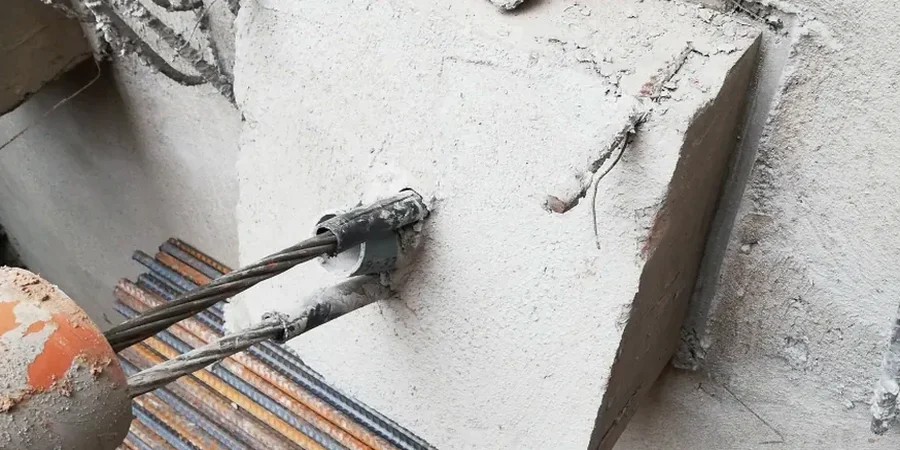
Ground anchors become necessary when space constraints prevent the use of a wide gravity wall or where very tall vertical excavations, such as deep basements, are required. They work by transferring tensile loads into competent soil or rock behind the active failure zone. This technique is often essential in Ashford for supporting existing embankments or deep excavations adjacent to sensitive structures, where cantilever solutions would be inadequate or generate unacceptable movement.
Designs must strictly follow Eurocode 7 (BS EN 1997) with the UK National Annex, and execution standards like BS EN 1537 for anchors. Planning permission may be required from Ashford Borough Council, especially if the wall is over one metre high and adjacent to a highway or a listed building. Building Regulations approval is needed for walls supporting a structure, and the CDM 2015 Regulations govern health and safety throughout the project lifecycle.