GEOTECHNICAL ENGINEERING1
ASHFORD
HomeImprovementVibrocompaction design

Vibrocompaction Design for Improvement in Ashford

Knowledgeable. Thorough. Resourceful.

LEARN MORE

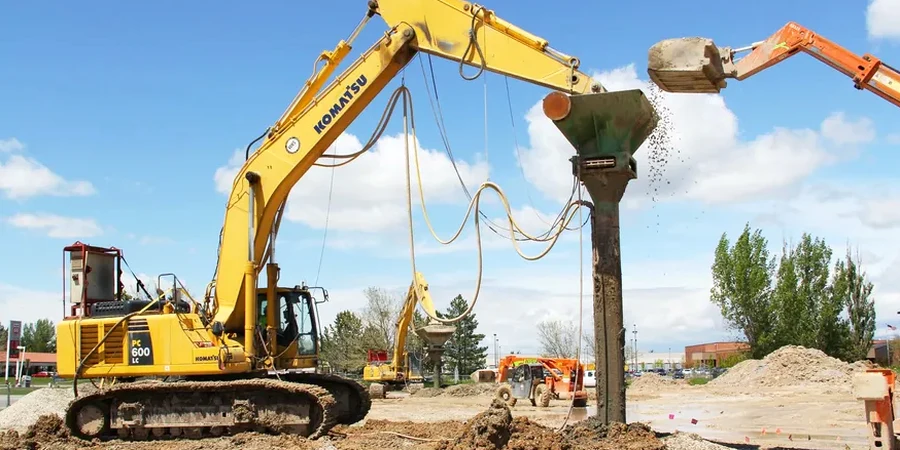
If you're developing on the Folkestone Beds south of Ashford, you already know the drill: sands and sandstones that look solid at first glance but can hide loose pockets that settle unevenly. The wet winters here, with groundwater perched on the Weald Clay, don't help either. That's where a solid vibrocompaction design comes in. We don't just hand you a generic spec. Our lab runs the grain-size distributions and fines content first, so the vibrator frequency and spacing match the actual material on your plot, not an assumption from a desk study. For sites near the Stour floodplain, we often pair the design with stone columns when the silt layers get too thick for pure compaction. The result is a ground treatment plan that will hold the 200 kPa bearing capacity your SE wants without overdesigning the probe grid and blowing your earthworks budget before the first brick goes up.

A vibrocompaction design is only as good as the grain-size curve it's based on: get the fines wrong and you'll be chasing pore pressures instead of density.
Our service areas

Scope of work

The Folkestone Formation dominates the geology around Ashford: medium-dense to dense fine-to-medium sands with occasional iron-cemented doggers. The silt content typically runs between 8 and 15 percent, which is the sweet spot for vibrocompaction, but only if the fines are non-plastic. We run Atterberg limits on every sample before we commit to a design, because plastic fines above 5 percent will kill the radial drainage and leave you with pore pressure buildup instead of densification. The water table around Ashford sits shallow, often less than 2 metres below ground level in winter, so we specify pre-drilling through any cohesive cap and factor in the backfill demand for the vibro points. Our team checks the target relative density against BS EN 1997-2:2007, usually aiming for Dr ≥ 70 percent under footings and 65 percent in the footprint, with post-treatment verification via CPT or zone load tests. When the site straddles the boundary between the Folkestone Beds and the overlying Gault Clay, we adjust the compaction grid asymmetrically because the lateral stress transfer differs across the contact: sand densifies, clay just remoulds, and you need to know where that line is before the rig arrives.
Vibrocompaction Design for Improvement in Ashford
Technical reference — Ashford

Area-specific notes

The mistake we see repeatedly across Ashford is treating the whole site to one uniform grid when the Folkestone Beds are anything but uniform. A contractor will run a 3-metre triangular grid, get a decent CPT trace in the open area, and call it done. Then six months later the corner of the attenuation tank settles 40 millimetres because that corner sat on a lens of silty fine sand that needed 2.2-metre spacing to hit the same density. It's not the rig operator's fault; it's a design that skipped the grain-size variability analysis. Another classic error is starting compaction within 3 metres of a retaining wall without checking the lateral stress path: the vibrations can temporarily reduce the passive resistance and the wall tilts. Our design includes stand-off distances and sequencing constraints for every structure on the plot, not just the building footprint. For brownfield sites near the old railway works, we also screen for obstructions that can deflect the vibrator and leave untreated columns hiding under the surface.

Need a geotechnical assessment?

Reply within 24h.

Email: contact@geotechnical-engineering1.com

Standards used


BS EN 1997-2:2007 – Ground investigation and testing, BS 5930:2015+A1:2020 – Code of practice for ground investigations, Specification for Ground Treatment (ICE, 2020)

Typical values

ParameterTypical value
Applicable standardBS EN 1997-2:2007, BS 5930:2015+A1:2020
Target relative density (Dr)≥ 70% under structural loads
Typical grid patternTriangular, 2.0–3.5 m spacing
Fines content limit<15% passing 75 µm, non-plastic
Max treatment depthUp to 18 m with top-feed system
Post-treatment verificationCPT, PMT, or zone load test
Vibrator power130–180 kW electric or hydraulic

Frequently asked questions


What does vibrocompaction design cost for a typical Ashford housing plot?

For a standard residential plot in Ashford, a full vibrocompaction design package including lab testing, design report, and trial supervision typically runs between £1.270 and £4.370, depending on the number of soil units and the verification testing scope. Sites with complex geology spanning the Folkestone Beds and Gault Clay contact will sit toward the upper end because of the extra lab work and asymmetric grid design.

When is vibrocompaction a better choice than stone columns in Ashford?

Vibrocompaction works best when the fines content stays below 15 percent and the material is genuinely granular, which matches much of the Folkestone Beds across Ashford. If the silt fraction creeps above 15 percent or the Atterberg tests show any plasticity, the drainage path closes during vibration and you'll be fighting pore pressure instead of compacting. In those conditions, stone columns become the more reliable option because they bypass the drainage problem entirely by introducing a clean gravel column.

How do you verify that the ground has actually been compacted enough?

We specify pre- and post-treatment CPT soundings at the same coordinates so you get a direct before-after comparison of cone resistance and sleeve friction. Acceptance is tied to a target relative density, typically Dr ≥ 70 percent under load-bearing elements, translated into a minimum cone resistance for the depth range. On larger Ashford commercial sites we may add zone load tests at the foundation level to confirm the modulus of subgrade reaction matches the design assumptions.

Location and service area

We serve projects across Ashford and surrounding areas.

View larger map