GEOTECHNICAL ENGINEERING1
ASHFORD
HomeSeismicBase isolation seismic design

Base Isolation Seismic Design in Ashford: Protecting Structures from Ground Motion

Knowledgeable. Thorough. Resourceful.

LEARN MORE

One mistake we keep seeing with new commercial builds on the Wealden Clay around Ashford is treating base isolation as an afterthought, something to specify once the superstructure drawings are already finalised. By that point the column grid, foundation stiffness and even the expansion joint layout are locked in, and the isolation plane ends up fighting the architecture instead of working with it. In our experience, the real benefit of seismic isolation comes when the isolator properties and the structural period are tuned together early, particularly on the stiff clays that extend from the town centre towards the M20 corridor. The 2007 Folkestone earthquake, though centred on the coast, sent enough high-frequency energy inland that several Ashford buildings experienced non-structural cracking, a reminder that moderate UK seismicity can still expose poorly detailed interfaces between the ground and the structure. We combine the site-specific MASW shear-wave velocity profile with the isolation design so the dynamic input matches the actual stratigraphy, not a generic Type D ground assumption.

An isolation system designed without a measured Vs profile is a guess. In Ashford the difference between limestone and alluvium can shift the bearing displacement by 30 percent.
Our service areas

Scope of work

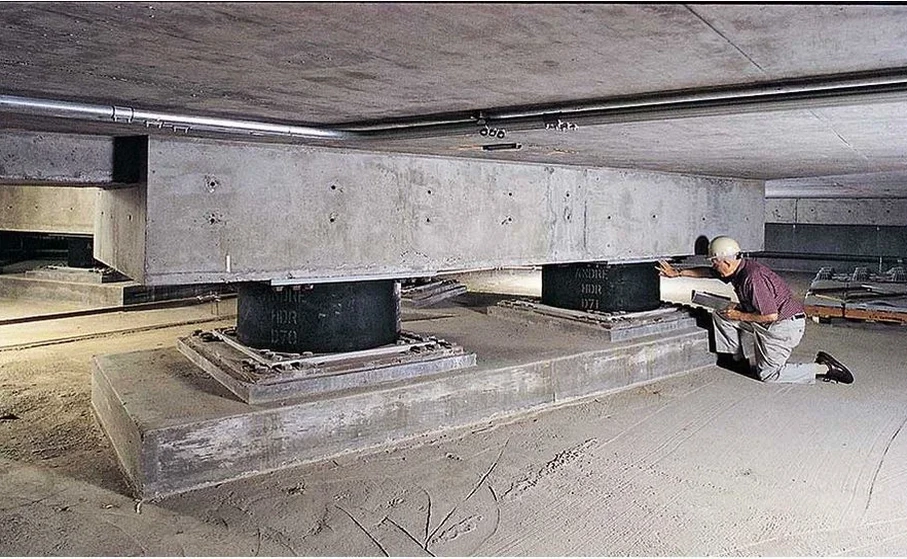
The ground conditions shift noticeably across Ashford even within a couple of miles. North of the railway line, around Kennington, the Hythe Beds limestone sits relatively shallow, giving a stiffer bearing stratum that transmits higher-frequency motion straight up into the structure, while the alluvial deposits near the Great Stour river corridor south of the town centre amplify longer-period energy and increase the settlement sensitivity of any isolation interface. What this means in practice is that a lead-rubber bearing calibrated for the Kennington side will not deliver the same displacement performance if replicated on the river gravels without adjusting the isolator diameter and rubber shear modulus. We have seen projects where the isolation period was set purely from a desk study and the actual ground meant the bearings were operating outside their design strain range, something that only shows up once the time-history analysis is run against the real Vs profile. We run the full suite: characterisation of the isolation system under MCE and DBE shaking per BS EN 1998, stability checks for the maximum considered displacement plus accidental torsion, and uplift verification at the corner bearings where the overturning moment concentrates on taller frames. The isolation plane detail matters just as much as the bearing selection, particularly the moat wall clearance, the flexible service connections, and the vertical gap for the uplift case.
Base Isolation Seismic Design in Ashford: Protecting Structures from Ground Motion
Technical reference — Ashford

Area-specific notes

One thing a local technician spots quickly on Ashford sites is that the Wealden Clay shrinks and swells seasonally, and when a base isolation moat wall is poured tight against that clay without a compressible backfill, the ground movement alone can close the seismic gap long before any earthquake arrives. We have measured moat clearances halved within two wet-dry cycles simply because the clay pressed against the retaining element. Another risk we flag early is the differential settlement between the isolated superstructure and the surrounding grade slab on the non-isolated side of the moat cover: the isolated side barely moves under gravity, while the external paving settles into the alluvium, and suddenly the cover plate binds. On the structural side, the biggest vulnerability is torsional coupling when the centre of mass and centre of rigidity are not aligned over the isolation plane, something that shows up clearly in the modal analysis but gets missed if only a simplified equivalent lateral force method is used. We always run the accidental eccentricity case per EN 1998-1 Clause 10.3, and on irregular-plan buildings in Ashford we push the analysis to nonlinear response history with at least seven ground-motion pairs matched to the uniform hazard spectrum.

Need a geotechnical assessment?

Reply within 24h.

Email: contact@geotechnical-engineering1.com

Standards used


BS EN 1998-1:2004 (Eurocode 8: Design of structures for earthquake resistance – Part 1), BS EN 15129:2018 (Anti-seismic devices), BS EN 1997-1:2004 (Eurocode 7: Geotechnical design – Part 1), BS 5930:2015 (Code of practice for ground investigations), UK National Annex to BS EN 1998-1

Typical values

ParameterTypical value
Isolator typeLead-rubber bearings (LRB), high-damping rubber (HDRB), flat sliding bearings (FPS)
Design standardBS EN 1998-1:2004, BS EN 15129:2018 (anti-seismic devices)
Seismic hazardUK National Annex to BS EN 1998, site-specific PGA 0.02–0.04g (475 yr)
Isolation period target2.0–3.5 s depending on superstructure flexibility and moat dimensions
Maximum displacementTypically 150–300 mm under MCE, verified by nonlinear time-history analysis
Ground condition influenceSite class B to D per BS EN 1998; Wealden Clay stiffness reduces isolation efficiency if neglected
Uplift checkCorner bearing tensile verification per EN 15129 Annex C, critical for slender frames
Moat wall detailClearance ≥ 1.2 × MCE displacement plus construction tolerance, fire-rated cover plate

Frequently asked questions


What does base isolation seismic design cost for a typical Ashford commercial building?

For a mid-rise commercial structure in the Ashford area, the engineering design, bearing specification, time-history analysis and construction-phase verification typically fall in the £3,480 to £6,650 range. The final figure depends on the number of bearings, the complexity of the superstructure and whether nonlinear response-history analysis is required. The bearing procurement and prototype testing costs sit outside this scope and are quoted separately once the isolator schedule is finalised.

How does the Wealden Clay affect the performance of seismic isolators?

Wealden Clay has a relatively high stiffness at small strains, which reduces the filtering effect of the soil column and transmits more high-frequency energy into the structure. If the isolation period is set too close to the site period, resonance can offset the benefit. We measure Vs directly with MASW or cross-hole methods to avoid this, and when the clay is desiccated near the surface we often recommend deepening the foundation to reach material with more consistent stiffness beneath the seasonal moisture-affected zone.

Can existing buildings in Ashford be retrofitted with base isolation?

Yes, but it depends on the structural typology. Buildings with a stiff load-bearing masonry or concrete frame and a clear basement or crawl space offer the most feasible retrofit path. The isolation plane is typically inserted at the top of the existing foundation by cutting the columns in sequence and installing the bearings on new pedestals. We assess the temporary support system, the transfer of services across the new moat, and the impact on the building's vertical circulation. Not every existing structure in Ashford is a candidate, and we evaluate feasibility case by case.

What ground investigation data do you need before designing the isolation system?

We need the shear-wave velocity profile down to at least 30 metres (Vs30) to assign the site class per BS EN 1998, plus the depth to bedrock if it is within 60 metres. Standard borehole logs with SPT N-values give us the soil layering and consistency, and laboratory dynamic tests on undisturbed samples provide the strain-dependent shear modulus degradation curves when the analysis demands a site-response study. In Ashford, where the Hythe Beds and Wealden Clay alternate over short distances, we also recommend at least two investigation points to capture lateral variability across the footprint.

Location and service area

We serve projects across Ashford and surrounding areas.

View larger map
ooter>