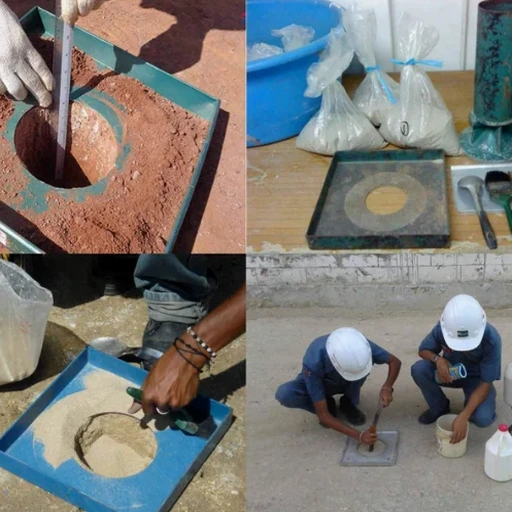
In-situ testing forms the backbone of reliable geotechnical investigation across Ashford, providing engineers and contractors with direct measurements of ground conditions without the disturbance caused by sampling and laboratory transit. This category encompasses a broad range of field tests that evaluate soil density, strength, permeability, and deformation characteristics in their natural state. For a town experiencing steady residential expansion and infrastructure upgrades, understanding the actual behaviour of the ground beneath a site is not just a regulatory requirement but a practical necessity to prevent future structural issues.
Ashford's geological profile presents a varied landscape shaped by the River Stour and its tributaries. Much of the urban centre sits on alluvial deposits, with the Lower Greensand Group outcropping in surrounding areas, particularly to the north and west. These sands and sandstones can exhibit variable density and are often overlain by softer, compressible clays and silts. The Weald Clay formation also appears in southern fringes, bringing shrink-swell potential that demands careful assessment. Such diversity means that in-situ methods must be selected wisely to capture the true ground profile, especially when dealing with the water-bearing sands that characterise parts of the Hythe Beds.
All in-situ testing in Ashford must comply with British Standards, primarily BS 5930:2015+A1:2020, the code of practice for ground investigations, alongside BS EN ISO 22476 for specific field tests. These standards define procedures, equipment calibration, and reporting requirements to ensure data reliability. Local planning authorities, including Ashford Borough Council, will typically require ground investigation reports that adhere to these standards as part of planning applications, particularly for developments in areas identified on the Environment Agency's flood maps or where previous industrial use raises contamination concerns.
Projects ranging from small residential extensions to large commercial developments on the Eureka Business Park rely on in-situ testing to inform foundation design. Road and rail infrastructure, including works associated with the M20 corridor and Ashford International station, also demand rigorous ground assessment. A classic example is the field density test (sand cone method), which remains a trusted technique for verifying compaction in trench backfill and highway subbases. Other common tests include plate load testing for bearing capacity, in-situ CBR assessments for pavement design, and percolation tests for sustainable drainage systems. Each test provides a piece of the puzzle, helping engineers avoid over-design or, worse, under-design of foundations and earthworks.
In-situ testing measures soil properties in their natural state, avoiding the disturbance that occurs during sampling and transport to a lab. This provides a more accurate representation of density, strength, and permeability for design, particularly in sensitive soils like Ashford’s alluvial deposits, where sample disturbance can significantly alter results.
BS 5930:2015+A1:2020 provides the overarching code for ground investigations, while BS EN ISO 22476 specifies requirements for field tests such as cone penetration, pressuremeter, and plate loading tests. Adherence to these standards is essential for planning approval and ensures test results are legally defensible and technically reliable.
The required tests depend on the geological conditions and the proposed structure. A desk study identifying local geology, such as the Lower Greensand or Weald Clay, guides the selection. A competent geotechnical engineer will design an investigation plan that typically combines boreholes with tests like the sand cone method for compaction or plate tests for bearing capacity.
Yes, percolation tests conducted in-situ are mandatory for designing soakaways and sustainable drainage systems. Given Ashford’s variable sands and clays, these tests directly measure the soil’s infiltration rate, ensuring drainage designs comply with Building Regulations and Environment Agency guidance, preventing future waterlogging or foundation issues.