GEOTECHNICAL ENGINEERING1
ASHFORD
HomeInvestigationCPT (Cone Penetration Test)

CPT Testing in Ashford: Fast Stratigraphy Without Drill Cuttings

Knowledgeable. Thorough. Resourceful.

LEARN MORE

Ashford sits on a patchwork of Atherfield Clay, Hythe Beds, and recent river alluvium from the Great Stour. The town’s expansion zones near Junction 10 of the M20 and the newer residential plots around Finberry often hit soft lenses that standard boreholes miss between sampling intervals. We see this pattern every month in our lab: a client brings SPT logs that look consistent, but the CPT trace reveals a thin peat seam at 4.2 metres that nobody anticipated. With the local water table sitting high—often within 1.5 metres of ground level in winter—undrained conditions complicate any excavation. When we run in-situ permeability profiles alongside CPT soundings, the combined dataset gives a much clearer picture of pore pressure dissipation before foundation design begins.

A continuous CPT trace catches thin silt seams between sand layers that interval sampling misses—and around Ashford’s river terrace deposits, those seams control the drainage behaviour of the whole foundation.
Our service areas

Scope of work

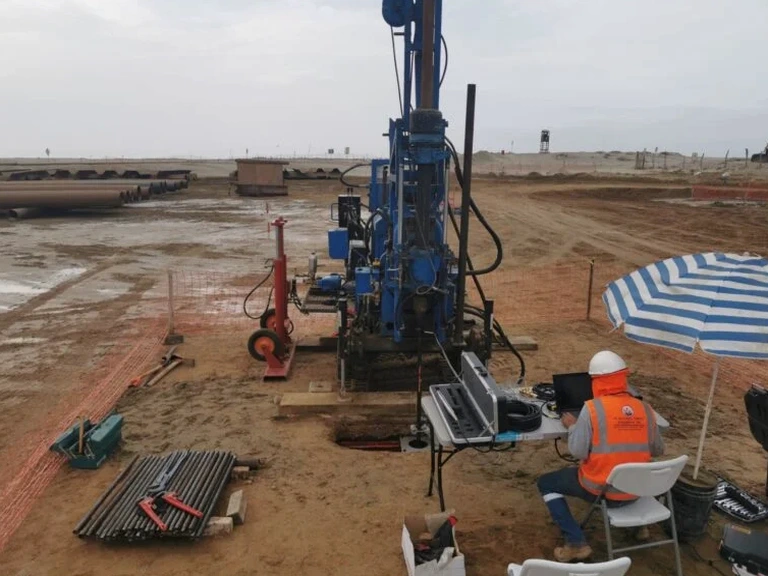
The most common mistake we see around Ashford is treating the Folkestone Beds as uniform sand. They’re not. In the western parishes, the sand runs relatively clean, but near the town centre and towards Willesborough, silt stringers and iron-cemented doggers create refusal risks that surprise inexperienced operators. Our CPT rigs measure cone tip resistance, sleeve friction, and dynamic pore pressure simultaneously, logging continuous profiles at 2 cm intervals. That means you catch the 15-centimetre silt layer that would completely change a bearing capacity calculation. Data acquisition follows BS EN ISO 22476-1:2012, and we calibrate the cones against reference load cells before every site mobilisation. On sites where the Greensand formation is particularly dense, we pair CPT soundings with SPT drilling to correlate local qc-to-N60 ratios, which improves confidence in the geotechnical model without doubling the drilling budget.
CPT Testing in Ashford: Fast Stratigraphy Without Drill Cuttings
Technical reference — Ashford

Area-specific notes

The ground between Ashford’s town centre and the newer developments south of the railway line tells two completely different stories. Near the International Station, made ground and historic fill overlie soft alluvium; cone resistance can drop below 0.5 MPa for several metres, and friction ratios spike in organic layers. Move half a mile south onto the Hythe Beds outcrop, and qc jumps above 15 MPa within the first three metres. A foundation design calibrated to one area fails in the other. The risk multiplies on brownfield plots where old chalk pits were backfilled with uncontrolled material—we have logged sleeves of brick rubble and ash that give erratic sleeve friction readings and make soil behaviour type classification unreliable without complementary sampling. Relying on a desk study alone in Ashford is asking for trouble; the CPT trace shows you exactly where the transition from competent sand to compressible silt occurs, metre by metre.

Need a geotechnical assessment?

Reply within 24h.

Email: contact@geotechnical-engineering1.com

Watch how it works


Standards used

BS EN ISO 22476-1:2012 (Geotechnical investigation and testing – Field testing – Electrical cone and piezocone penetration test), BS 5930:2015 (Code of practice for ground investigations – UK-specific guidance on CPT interpretation), Eurocode 7 BS EN 1997-2:2007 (Ground investigation and testing – includes CPT-derived design parameters)

Typical values


ParameterTypical value
Maximum penetration depth20 m (standard); deeper on request depending on rig access
Cone tip resistance (qc) range0.1 to 100 MPa (standard 15 cm² cone)
Sleeve friction (fs) range0.001 to 1.0 MPa typical, logged at 2 cm intervals
Pore pressure transducerU2 position (shoulder), saturated filter element per ISO 22476-1
Logging interval20 mm (continuous digital acquisition, no skipped depth increments)
Soil behaviour typeRobertson (1990) classification output in real time
Reporting deliverablePDF log + AGS 4 data file + dissipation test plots if run
Typical penetration rate20 mm/s ± 5 mm/s as per BS EN ISO 22476-1 class requirements

Frequently asked questions

How much does a CPT test cost in the Ashford area?

For single-family residential sites and standard commercial plots around Ashford, CPT testing typically runs between £140 and £220 per sounding, depending on depth required and whether dissipation tests are included. We still offer straightforward pricing—call us with the postcode and target depth, and we will give you a firm number before the rig leaves our yard.

Can CPT replace boreholes completely on an Ashford site?

In the Folkestone Beds sands, CPT gives excellent continuous data and often reduces the number of boreholes needed, but it does not recover physical samples for visual classification or laboratory testing. On sites with made ground or variable fill—common near the town centre—we recommend combining CPT with at least one trial pit or window sampler borehole to verify the soil behaviour type classification against real material.

How long does a CPT sounding take, and will it hold up our programme?

A single 15-metre push in Ashford’s typical sands takes around 15 to 20 minutes of penetration time, plus setup and any dissipation pauses. Most standard residential jobs are completed within half a day on site. We send the AGS data file and PDF logs the same day, so the groundwork contractor is not waiting for results.

What happens if the cone hits refusal in the Hythe Beds?

The Hythe Beds can contain cemented sandstone layers that cause refusal before target depth. When this happens, we log the refusal depth and cone resistance at refusal, and usually recommend pre-drilling through the hard layer with a rotary rig so we can continue the CPT push below it. The refusal depth itself is a useful data point for pile toe design.

Location and service area

We serve projects across Ashford and surrounding areas.

View larger map
ooter>