GEOTECHNICAL ENGINEERING1
ASHFORD
HomeGeophysicsElectrical resistivity / VES (Vertical Electrical Sounding)

Electrical Resistivity Testing & Vertical Electrical Sounding in Ashford

Knowledgeable. Thorough. Resourceful.

LEARN MORE

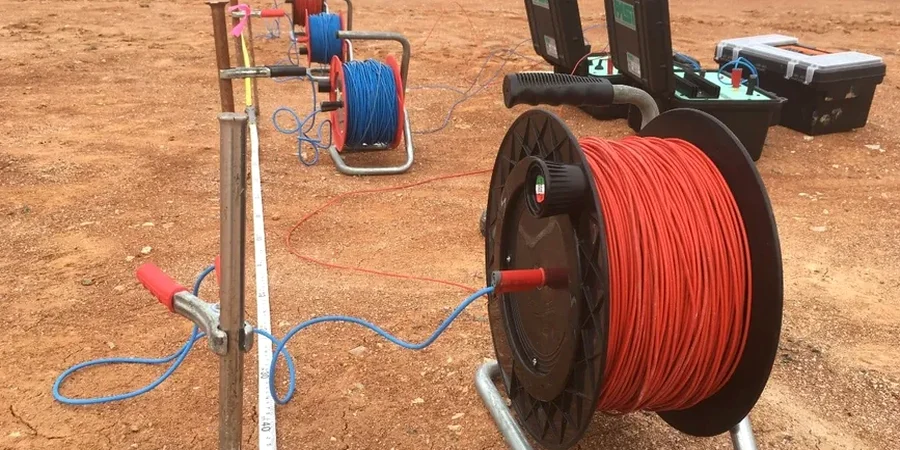
Plenty of firms drill a borehole in Ashford and walk away thinking they have the full picture, only to hit a buried channel of River Stour gravel that the point data missed. That gap between boreholes is where electrical resistivity earns its keep. Vertical Electrical Sounding maps the subsurface continuously, revealing transitions between the Wealden Clay, the Hythe Beds, and any sand lenses that could play havoc with foundation design. We run Schlumberger and Wenner arrays across sites from the Eureka Park business quarter to the rural fringes near the North Downs, delivering 2D profiles that flag low-resistivity zones tied to groundwater or high-resistivity anomalies that often mean gravel pockets. For a town growing as fast as Ashford—with 80,000 residents and major infrastructure like the M20 corridor and HS1 rail link—integrating geophysics early avoids the costly surprise of hitting running sand halfway through a piling programme. Many ground investigation specs under Eurocode 7 now expect a geophysical layer precisely because a single borehole log cannot interpolate what happens between two points ten metres apart.

A resistivity profile doesn’t guess what’s between boreholes—it measures it, giving you a continuous cross-section rather than isolated point data.
Our service areas

Scope of work

Ashford’s expansion from a medieval market town to a modern rail hub means the ground beneath new builds is anything but uniform. The historic core sits on river terrace deposits, while the newer developments south of the A2070 push onto the stiff clays that give the Weald its character. Electrical resistivity methods cut through this patchwork by measuring how easily current flows through each layer. Saturated clay conducts well and reads low; dry sand or compact gravel resists the flow and spikes high. Our team models the apparent resistivity curves with iterative inversion software, matching the field data to stratigraphy logged in nearby trial pits or boreholes. The output is a calibrated cross-section that shows layer thickness, depth to bedrock, and any lateral pinch-outs that could concentrate groundwater flow. When combined with laboratory grain-size analysis on samples from key horizons, the resistivity profile becomes a predictive tool rather than just a pretty colour plot. BS 5930:2015 explicitly recognises geophysical surveys as a valid means of ground investigation, and for good reason—a well-executed VES survey in Ashford can often reduce the number of invasive points required, saving programme time without sacrificing confidence in the ground model.
Electrical Resistivity Testing & Vertical Electrical Sounding in Ashford
Technical reference — Ashford

Area-specific notes

The contrast between the town centre and the outskirts tells a story. Around Victoria Road and the Designer Outlet, you’re dealing with made ground over river gravels—highly variable, with old cellars and backfilled channels that a standard resistivity line picks up as sharp lateral changes. Out towards Kingsnorth, the ground shifts to Gault Clay and the Folkestone Beds, where the risk is less about voids and more about perched water tables sitting on silt lenses. A VES sounding that shows a sudden drop in resistivity at three metres in Kingsnorth is probably a saturated silt layer that will turn a trench into a swimming pool if nobody knows it’s there. Ashford’s geology doesn’t read the planning application before causing problems. The resistivity method gives you a heads-up: a low-resistivity band at depth might be saltwater intrusion near the Romney Marsh fringe, or it could be clay with a higher moisture content that will soften under load. Without that geophysical layer, the ground model is built on assumptions, and assumptions in the Weald have a habit of proving expensive once the excavator starts turning.

Need a geotechnical assessment?

Reply within 24h.

Email: contact@geotechnical-engineering1.com

Standards used


BS 5930:2015, Eurocode 7 (BS EN 1997-1:2004), BS 1377

Typical values

ParameterTypical value
MethodologyVertical Electrical Sounding (VES) – Schlumberger and Wenner arrays
Typical investigation depth2 m to 80 m below ground level, depending on array spread
Interpreted outputsLayer resistivity (Ohm·m), thickness, depth to bedrock, groundwater indicators
Data inversion softwareRES2DINV / EarthImager 2D with smoothness-constrained least-squares
Complementary techniques2D ERT profiling, induced polarisation (IP) for contamination mapping
Reporting standardBS 5930:2015 + AGS 4 data format for digital deliverables
Typical array lengthAB/2 up to 150 m for deep soundings; shorter spreads for high-resolution near-surface
Site coverageSingle soundings to multi-line 2D grids across Ashford and wider Kent

Frequently asked questions


What depth can a VES survey reach in the Wealden Clay around Ashford?

Practical investigation depth depends on the array spread. With a maximum AB/2 electrode separation of 150 metres, we can typically resolve strata down to 60–80 metres below ground level in the clay formations common across Ashford. The actual depth of penetration is limited by the current output of the resistivity meter and the background noise level, which can be higher near the railway lines and the M20 corridor.

How does resistivity help distinguish between clay and water-bearing sand on an Ashford site?

Saturated Wealden Clay typically returns resistivity values below 20 Ohm·m, while clean water-bearing sands and gravels sit in the 50–150 Ohm·m range. The contrast is sharp enough that the inversion software can resolve the boundary with good confidence. Dry gravel or made ground can spike above 200 Ohm·m, which is why we always calibrate against at least one borehole or trial pit log to anchor the interpretation.

Can electrical resistivity detect buried structures or old foundations in Ashford town centre?

Yes, and this is one of the more common applications on brownfield sites around the town centre. Brick, concrete, and air-filled voids all present high-resistivity anomalies against the conductive clay background. A 2D ERT line run across a suspected former mill site or backfilled cellar will usually show a sharp resistive feature that can be targeted with follow-up intrusive investigation.

How much does an electrical resistivity survey cost for a typical Ashford residential plot?

For a standard residential plot in Ashford, a VES survey with two to three soundings and a basic interpretative report generally falls between £510 and £720, depending on access conditions and the number of array spreads required. Larger commercial sites needing multi-line 2D tomography are quoted on a project-specific basis after a desk study review.

Is resistivity surveying affected by the overhead lines or buried services common in Ashford’s industrial areas?

Overhead power lines and buried metallic services can couple with the injected current and degrade data quality, particularly on Wenner arrays. We mitigate this by running pre-survey utility clearance, selecting array orientations perpendicular to known linear features, and applying notch filters during processing. On heavily congested sites near the Eureka Park industrial zone, we may recommend a hybrid approach combining resistivity with ground-penetrating radar for the shallowest two metres.

Location and service area

We serve projects across Ashford and surrounding areas.

View larger map